
Running a Sex Offender Check in Dallas County
The Iowa Sex Offender Registry, maintained by the Iowa Department of Public Safety and Division of Criminal Investigation, is the main public search. It is generally updated hourly during weekday business hours. A basic Dallas County sex offender check does not require an account, but the visitor must accept the site's terms before searching. Search by a known name or use place tools for a city, ZIP code, county, map, or radius. The public site also offers telephone and email modes.
The Dallas County Sheriff's Office provides a second route. A person may request registry information by telephone, in writing, or in person. Supply a name and one extra identifier, such as a date of birth, address, internet identifier, telephone number, or Social Security number. Iowa law permits a countywide list request, and the sheriff charges no fee for this registry information. This local channel matters because Dallas County warns that its display may not contain the county's full list.
Dallas County Registry Search Agreement
Before a Dallas County registry search opens, Iowa requires acceptance of its use agreement. The terms explain three limits that shape a careful search. Data may be incomplete, map points are based on best-effort location work, and automated collection is restricted. A map pin should therefore be checked against the profile's written address and status. A missing pin is not proof that no registrant is tied to the area.
The official Iowa registry search screen shows the terms and public search entry point.
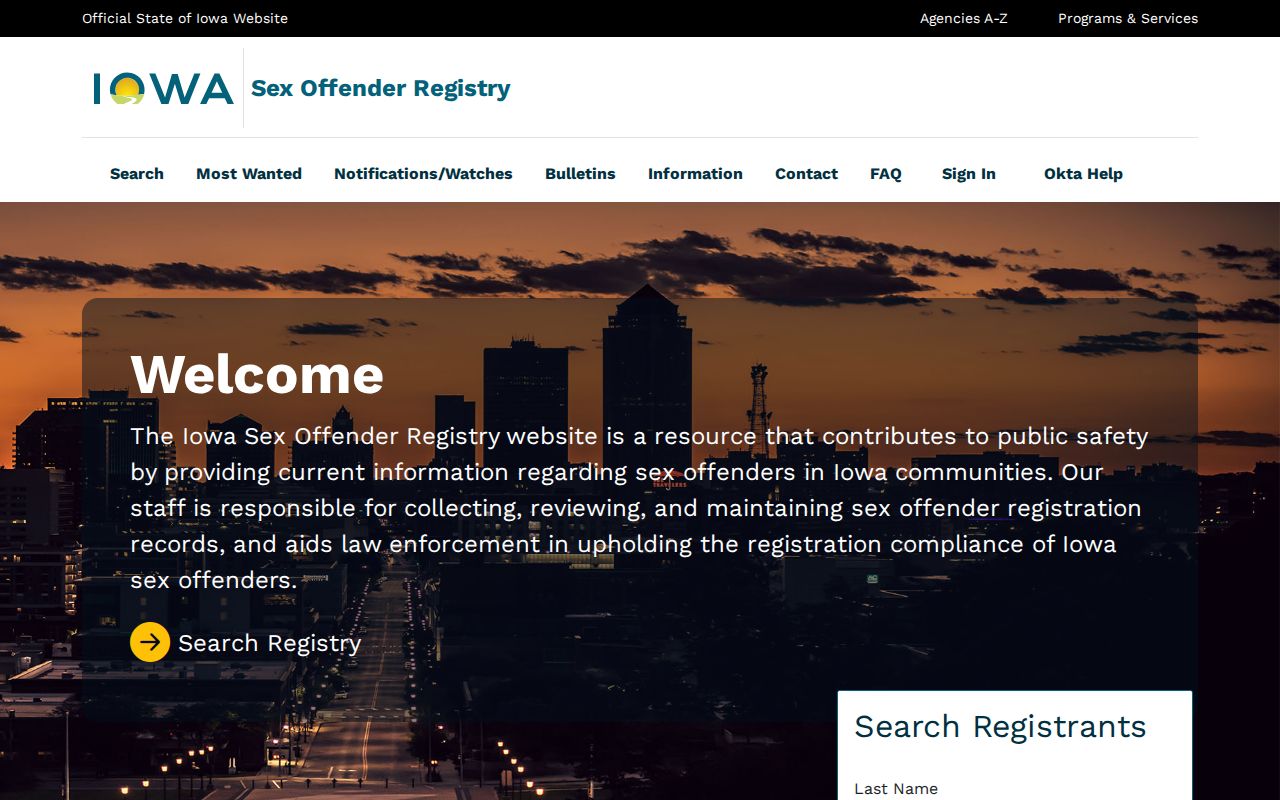
That interface is the correct first stop for a Dallas County name or location query because it reflects the state registry rather than a copied list.
Searching the Iowa Sex Offender Registry
Prepare the most precise facts available before searching. A name search may be expanded to aliases, while a place search can focus on Dallas County or a smaller area. Check the written profile after opening a result, especially when two people share a name or when a mapped location sits near a county line.
- Open the official registry and read and accept its conditions of use.
- Enter a last name and first name, or choose a place-based search by city, ZIP, county, map, or radius.
- Select “Also Search Aliases” when a former name or nickname may matter.
- Open the matching profile and compare identity details, address, offense, photographs, and restriction flags.
The public controls support several ways to narrow a Dallas County sex offender check. No single basic field is stated as mandatory.
| Field Label | Type | Required | Notes |
|---|---|---|---|
| Last Name | Text | No or unspecified | Starts a basic name search. |
| First Name | Text | No or unspecified | Narrows a surname match. |
| Also Search Aliases | Checkbox | No | Expands the query to listed aliases. |
| ZIP Code | Text | No | Limits results to a geographic area. |
| County, City, or Radius | Search mode | No | Iowa law requires these public location routes. |
Dallas County Registry Change Alerts
Repeated manual searches are not the only way to watch a Dallas County area. The Iowa registry offers free watches through an Okta account. A watch may follow additions, deletions, or changes within a ZIP code, a selected radius, or one registrant's record. The registry says an email notice is sent within 60 minutes after a tracked change.
Set the watch area with care. A wide radius can produce many notices, while a narrow one may omit a nearby address just across the boundary. Each alert is a prompt to reopen the current official profile. It is not a substitute for the profile, and it does not establish what occurred between updates. For a suspected missing Dallas County entry, use the sheriff route rather than relying on alerts alone.
What a Registry Profile Shows
An Iowa public profile combines identity, appearance, residence, offense, and restriction information required by chapter 692A. It does not reveal every item kept by law enforcement. Employer and school information are outside ordinary online disclosure, though a sheriff request may add school, employer, temporary lodging dates, and vehicle details. Victim identity, fingerprints, DNA, government identification numbers, professional-license data, and Social Security numbers are not public profile fields.
| Name & Aliases | Legal name plus listed nicknames and aliases. |
|---|---|
| Photo & Description | Photographs, physical traits, and scars, marks, or tattoos. |
| Residence | The public registered residence and related location information. |
| Offense & Statute | The qualifying offense with statutory citation and text. |
| Tier | The offense-based Iowa tier, not a personal risk score. |
| Restriction Flags | Indicators for residency and exclusion-zone restrictions. |
Read each field in context. The profile describes registration duties tied to a qualifying offense; it does not predict future conduct.
Dallas County and National Registry Searches
The National Sex Offender Public Website adds a cross-state layer for a person who may have moved or who has ties outside Iowa.
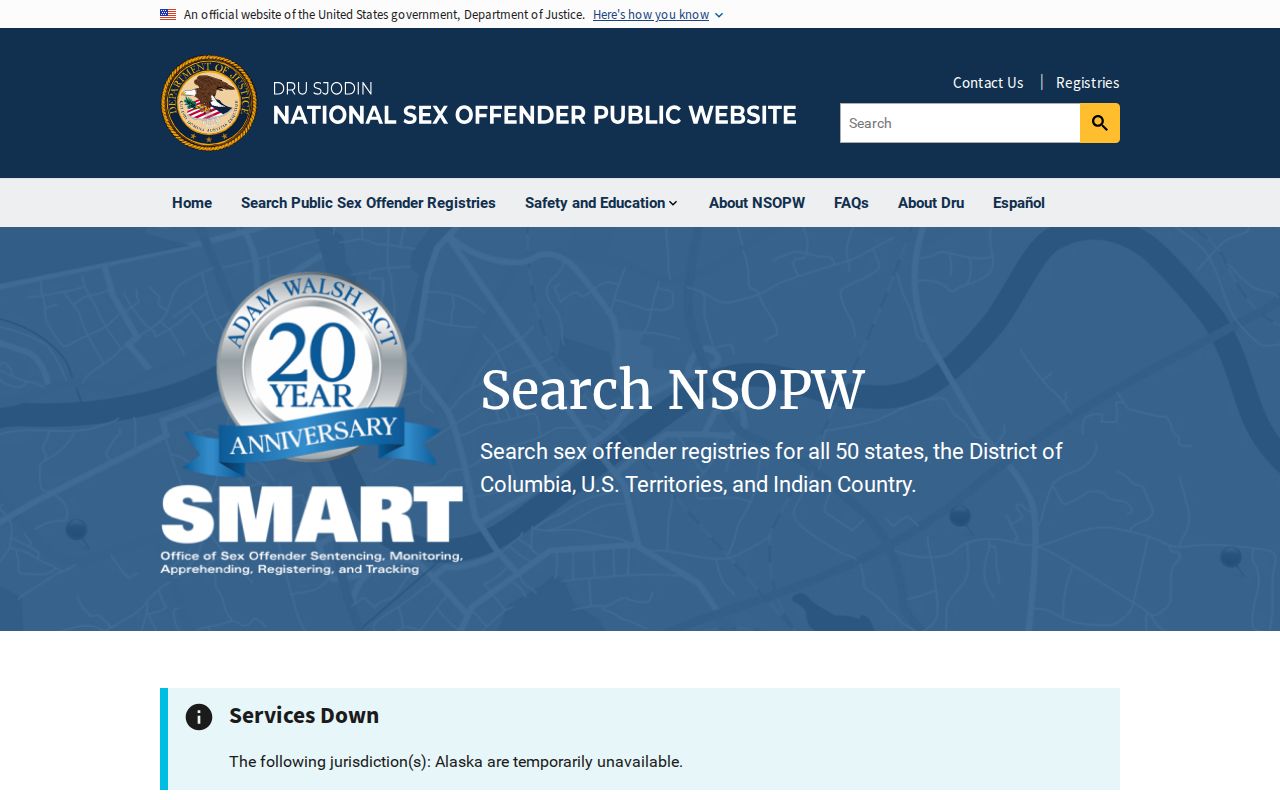
The national tool searches participating jurisdictions, while Iowa's registry remains the authoritative source for Iowa profile detail and Dallas County search options.
Use both tools for different jobs. Start with Iowa when the address, city, or ZIP is in Dallas County. Use NSOPW when the search crosses state lines, then follow each result back to the maintaining jurisdiction. Different public systems can update on different schedules. A national result should not be treated as more current than the state record that supplies it.
Registration Requirements and Levels in Iowa
Iowa's tiers classify qualifying offenses. They are not individualized scores of how dangerous a person may be. Verification becomes more frequent as the tier rises. Iowa Code section 692A.106 sets an ordinary ten-year registration period, but a special sentence can control and may last longer. Revocation can restart the calculation upon release, so the familiar federal shorthand of ten years, twenty-five years, or life should not be pasted onto an Iowa profile.
| Tier | Duration | Verification |
|---|---|---|
| Tier I | Ordinarily ten years unless another rule applies | Annually |
| Tier II | Controlled by Iowa section 692A.106 and any special sentence | Every six months |
| Tier III | May extend beyond ten years when a special sentence applies | Every three months |
Registrants pay a $25 annual sheriff fee. Iowa permits extra time, installments, or waiver when the person cannot pay. A photograph must be updated at least once each year.
Missing Dallas County Registry Results
A person who seems absent from the map may still appear through another official search mode. Try the legal name with aliases, switch from ZIP to county or radius search, and inspect nearby written addresses. Mapping errors and update timing can explain some gaps. The registry itself cautions that its database and map may not be complete.
The Dallas County sex offender information page gives the local warning and reporting route.
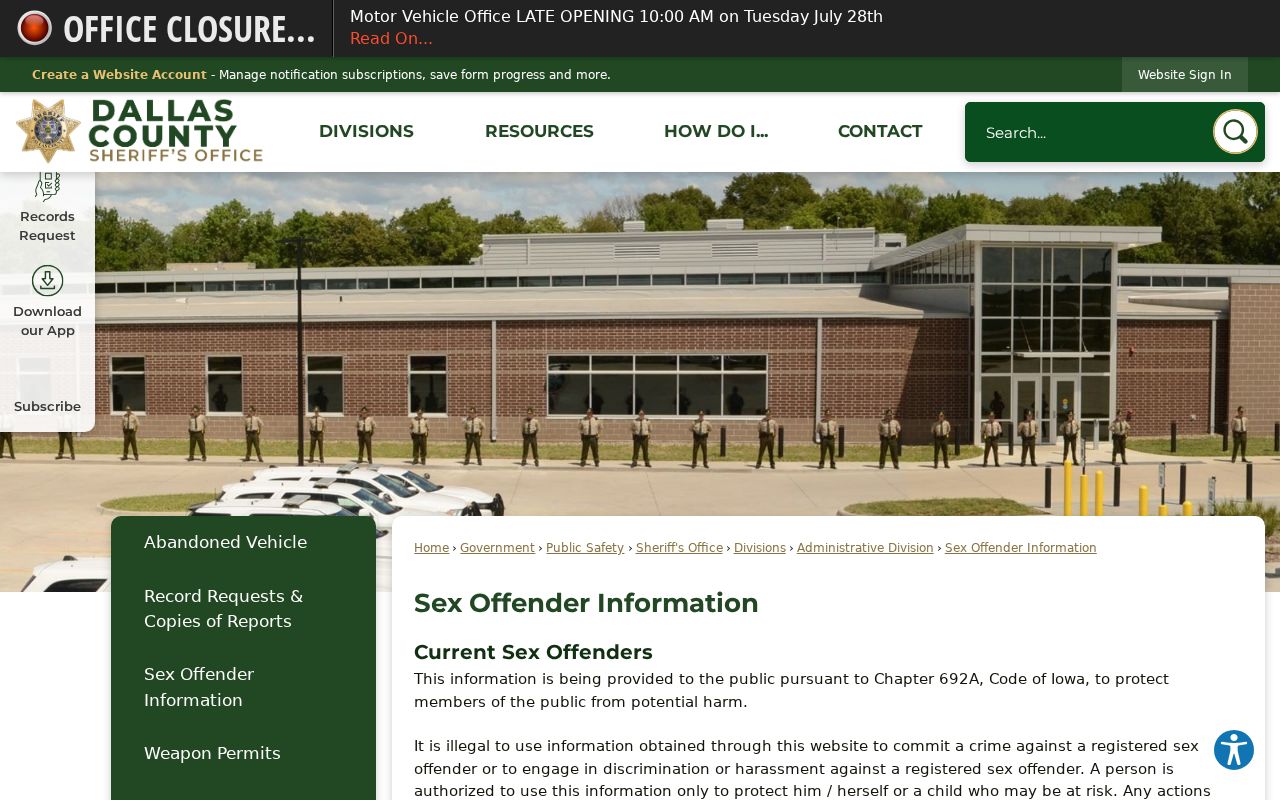
This county channel is useful when a public map seems wrong because the sheriff can accept a no-fee information request or a report of suspected noncompliance.
Call the Dallas County Sheriff's Office at 515-993-4771 or contact it at 28985 Thin Blue Line Lane, Adel, IA 50003. Report suspected crimes or registration violations to law enforcement. Do not investigate, approach, or confront a registrant.
Lawful Use and Community Notification
Registry information supports personal, family, and community safety. It can help a resident review an area, set an official watch, or share a factual concern with police. The legal limits are just as important. Iowa's agreement bars threats, assault, vandalism, and harassment. Readers should also avoid treating a tier as a personal risk rating or a map point as a guarantee of current location.
Use registry data lawfully: Misusing Iowa Sex Offender Registry information to threaten, harass, assault, or damage property is prohibited under Iowa Code chapter 692A.
When a profile raises a safety issue, save the exact official page and contact the proper agency. Emergencies belong with emergency services. Suspected Dallas County noncompliance belongs with the sheriff or the police agency for the location. Registry data should inform lawful safety steps, not public confrontation or punishment.
Dallas County Registry Contact Options
Dallas County offers more than the online map. The sheriff accepts a registry request by phone, in writing, or at its counter. Ask with a name plus one additional identifier. A countywide list is also available without a fee under Iowa Code section 692A.121. This is a strong fallback when a web search fails, when an alias is uncertain, or when a resident needs to ask about a suspected omission.
Dallas County Sheriff's Office
28985 Thin Blue Line Lane
Adel, IA 50003
515-993-4771
Administrative hours: weekdays, 8:00 a.m.-4:30 p.m.
Give staff enough detail to distinguish the subject. The sheriff may provide more statutory information than the standard online profile, but protected fields remain nonpublic. The Dallas County Sheriff's Office page confirms the agency contact, while the sheriff forms hub routes residents to other county forms and public-safety resources.
Keep a copy of the terms accepted, the search facts used, and the date checked. If the state profile and sheriff response conflict, ask the sheriff which item is current and report suspected noncompliance through law enforcement. That direct comparison is more sound than repeating an old map result or relying on a copied registry page that may have missed an update.